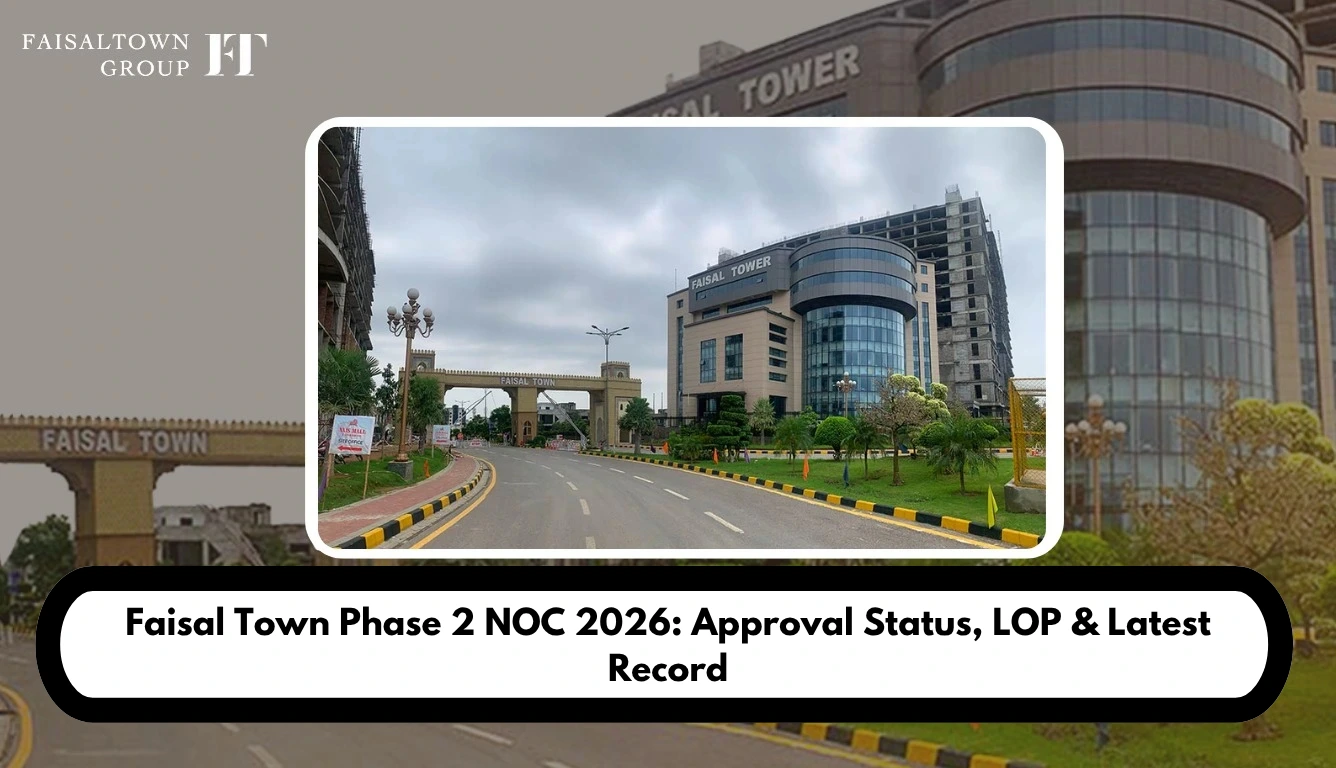
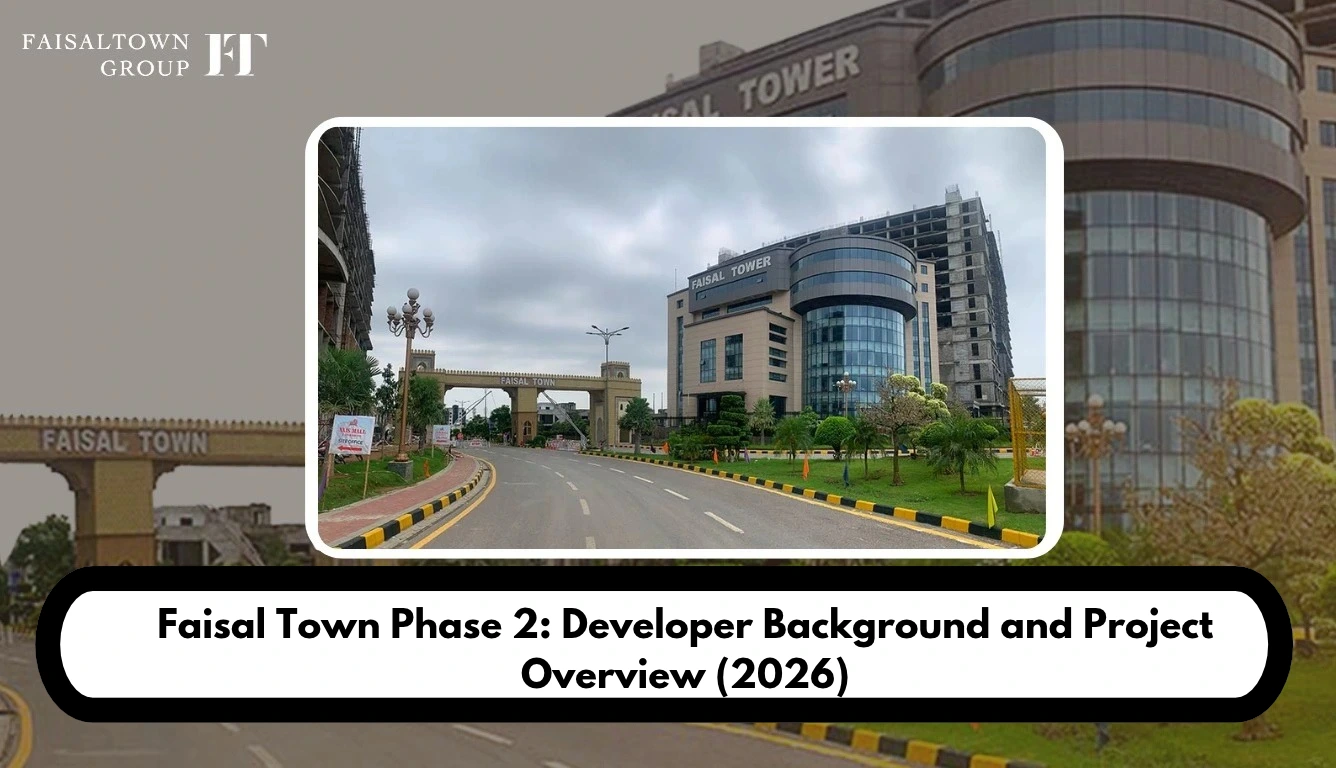
Picture a buyer holding a glossy brochure. The Faisal Town logo sits at the top, and the chairman’s name appears on the second page. But the Faisal Town Developer name alone does not tell you who owns the land, who sells the plot or whose bank account receives the booking money. Those answers sit in other documents.
This guide looks at the Faisal Town Developer question using the records and reports available today. We’ll go through the chairman, the link between Faisal Town Group and Zedem International, and the history of the original project. After that, we’ll examine Faisal Town Phase 2 and its approval status. Where evidence is solid, I say so. Where it isn’t, I say that too. You’ll also get a checklist to use before you sign anything.
Who Is Behind the Project?
Ask five sources and you’ll get more than one answer. Most pages name Zedem International (Pvt.) Ltd. as the developer of Faisal Town Phase 2, and ProPakistani’s property section describes Phase II as a ZEDEM International project. Other pages say Zedem only handles marketing, while CAM Construction (Pvt.) Ltd. does the development. A dealer page adds yet another name, “Faisal Town Private Limited.”
Why does this matter? Because the roles carry different legal weight. A developer carries out or arranges the development work. A marketing agent sells on someone else’s behalf. The landowner holds the ownership rights, and a sponsor promotes or finances the scheme. One company can fill all four roles, but nobody should assume it does.
I did not find a company registration extract, a land-ownership record or a signed agreement that settles the matter. So for now, “Faisal Town Developer” points to a cluster of related names and not to one proven legal person. The sections below take those names one at a time, starting with the person most often attached to the project.
Leadership and the Chairman’s Background
Chaudhry Abdul Majeed is the name you’ll see most often. ProPakistani reported him as the owner of Faisal Town and said he has delivered several projects in the twin cities. One third-party page calls him Chairman of Faisal Town Group, though it points to no corporate record for that title.
Those descriptions show a clear association. They don’t show that he personally owns the land. A chairman can lead a group of companies while the land sits in the name of a different entity. For that reason, a chairman’s name can never stand in for a land record.
You may also come across longer biographies online, with past offices in other societies and claims about decades of experience. I found those only on dealer pages, so I’m leaving them out. Without a primary source, they’re just talk.
Here’s the practical takeaway. The chairman’s position tells you who leads the group. It doesn’t tell you who signs your agreement, and that’s the part that affects your money.
Faisal Town Group and Zedem International: The Connection
Public pages treat Faisal Town Group and Zedem International as if they were the same thing. One third-party profile says Faisal Town Group was formerly known as Zedem International. Another describes Phase 2 as developed by Zedem under Faisal Town Group. A third says Zedem markets the project while CAM Construction builds it.
None of these pages cites a corporate document. So the evidence supports a loose association, and that’s all. It could mean one company that changed its name. It could also mean a parent and a subsidiary, or two separate firms with shared leadership. The sources can’t tell us which.
The gap shows up quickly at the point of purchase. Say the brochure carries the Faisal Town Group logo, the booking form names Zedem International and the payment slip shows a third account. Each mismatch might have a simple explanation. Still, you should get that explanation in writing before you pay.
An extract from the Securities and Exchange Commission of Pakistan would clear much of this up. Meanwhile, the company’s about page shows how the group describes itself. That’s useful context, but a self-description isn’t a legal record.
Company Structure and Legal Responsibilities
Three company names turn up across the sources: “Zedem International (Pvt.) Ltd.,” “Faisal Town Private Limited” and “CAM Construction (Pvt.) Ltd.” I use the “(Pvt.) Ltd.” label only where a source printed it, and no registration document was available to confirm any of them.
Registration proves a company exists. It doesn’t prove the company owns the land, holds development rights or has an approved layout. So the Faisal Town Company question needs several documents working together.
A buyer should ask which entity holds each of these five roles:
- Promoting the project.
- Arranging the development.
- Owning the land or holding the development rights.
- Managing allotments and customer records.
- Receiving payments and accepting contractual duties.
Here’s a small but telling detail. One dealer page tells buyers to issue a pay order in the name of “Faisal Town Phase II.” That’s a project name, not a legal entity. Your receipt should carry a registered company’s name, because that’s the party who owes you the obligations in your agreement.
Faisal Town Islamabad: Original Project Background and History
The original scheme has a better paper trail than Phase 2. Property portals describe Faisal Town Phase 1 as RDA-approved over 4,735.90 kanals, with three blocks (A, B and C) in the F-18 area near Fateh Jang. Developer-linked pages say Faisal Hills and Faisal Margalla City also hold RDA approval.
All of that comes from portals and developer-linked pages, so treat it as secondary. I couldn’t retrieve the RDA approval letter or the official layout plan. The developer’s Phase 1 page offers its own account of the history if you want to compare.
The name “Faisal Town Islamabad” can send readers in the wrong direction. One page places the project inside “CDA Sector F-18,” while most others put it under the Rawalpindi Development Authority. A sector label or a marketing name doesn’t decide jurisdiction. Only the authority’s own record does.
One more point deserves emphasis. Phase 1’s approval doesn’t carry over to Phase 2. The two sit on different land, and each parcel needs its own layout plan and permission. Phase 2 therefore gets its own review below.
Faisal Town Phase 2: Project Overview and Developer Responsibility
Faisal Town Phase 2 is marketed as a large residential and commercial development near the Thalian Interchange on the M-2 Motorway. The company’s location page explains the site and how to reach it. Portal listings show plot sizes from about 5.56 marla up to 2 kanal.
The land area is where the sources part ways. A ProPakistani property listing puts Phase II at 20,000 kanals, with 7,300 kanals approved. Newer third-party pages cite roughly 80,000 kanals. Those numbers may describe different things, like an approved first parcel versus a wider marketed vision. Nobody reconciles them, so none of the three should be read as the official area.
The master plan raises a similar issue. Some pages credit Meinhardt Group with the design, and others credit Zedem’s in-house team. You can see the marketed layout on the company’s master plan page. It shows how the developer presents the scheme. It doesn’t show that a regulator approved it.
Progress claims need dates too. Developer pages mention levelling, roads and drainage in several sectors, and one portal says Sector O was nearing possession timelines in mid-2026. I couldn’t confirm any of that independently. When you read the payment plan, ask for dated progress records alongside it.
Faisal Town Phase 2 Approval Status: What Do Official Records Establish?
Jurisdiction comes first. Most sources place Phase 2 under the Rawalpindi Development Authority (RDA). One page says the NOC application went to the Punjab Housing and Town Planning Agency (PHATA), and a third-party page says the PHATA portal lists Phase 2 under Rawalpindi Division, Attock District, marked “Under Process.” The sources disagree about who holds the file, so the authority itself has to settle that.
A few terms make the rest easier to follow. A layout plan is an approved plan that defines plots and designated areas. An NOC is a permission whose effect depends on who issued it, how it’s worded and what conditions come with it. A marketing master plan presents a proposed scheme and carries no regulatory force on its own. Approval scope means the exact land, phase and entity a document covers.
Now the record itself. ProPakistani reported that RDA issued an NOC for 7,300 kanals under letter number RDA/MP&TE/F-PHS-TAX-19/960/2022. The same report noted that the RDA website still showed Phase 2 as “illegal.” The copy I reviewed had no date, and I never found the letter.
Newer reports point the other way. A page on the developer’s own site says a summary of RDA’s portal dated 8 October 2026 lists 78 records. It names Faisal Town (Rev & Extension), Faisal Hills, Faisal Hills-II and Faisal Margalla City, but not Phase 2. Several third-party pages also say Phase 2 has no final NOC and remains “under process.”
I checked these sources on 20 October 2026. I did not open the RDA or PHATA portals myself, so that’s a limit of this research. The reviewed records don’t show a confirmed, phase-specific approval. Get the current position from the authority in writing, then compare it with what the developer’s NOC page says.
Faisal Town Management: Who Handles Development and Buyer Transactions?
Leadership and daily management are two different jobs. A chairman sets direction. Operational teams handle allotments, receipts, transfers and complaints. The sources don’t explain how Faisal Town Management splits those tasks.
Some pages link construction to CAM Construction (Pvt.) Ltd. and link marketing and sales to Zedem International. Others give everything to Faisal Town Group. Without a written disclosure, a buyer can’t tell who answers for a delay or a refund.
Put these six questions to the sales office in writing:
- Who signs the allotment letter?
- Who issues receipts?
- Who handles transfers?
- Who answers complaints?
- Who manages possession and handover?
- Who carries the duty to refund?
Remember that a dealer’s right to market a plot doesn’t automatically include the right to collect money. If an agent or another company receives funds, ask for written authorization. And if the answers stay vague, treat the management structure as unconfirmed.
Developer Claims Versus Verified Information
Different documents answer different questions. This table shows what each subject needs and what I found.
| Subject | Evidence to examine | What this review found |
| Developer identity | Company records, agreements | Zedem, CAM Construction and Faisal Town Group all appear; legal roles unconfirmed |
| Chairman’s role | Official organizational sources | Chaudhry Abdul Majeed reported as owner and chairman; no corporate record located |
| Faisal Town Group | Corporate records | Association described; legal structure not documented |
| Zedem International | Company records, project papers | Named as developer or marketer, depending on the source |
| Original project | Dated authority records | Phase 1 reported RDA-approved at 4,735.90 kanals; letter not retrieved |
| Phase 2 land area | Official land and planning records | 7,300, 20,000 and 80,000 kanals all reported; unreconciled |
| Layout plan and NOC | RDA or PHATA records | Reported NOC for 7,300 kanals (undated report); later reports say none confirmed |
| Master plan | Plan and approval record | Design credited to Meinhardt or in-house team; approval not located |
| Development and possession | Dated, verifiable evidence | Developer-stated; not independently confirmed |
A chairman’s profile can’t replace a land record. In the same way, one project’s approval can’t speak for another project. And where the table says “not located,” that describes the sources I checked. It doesn’t prove the document doesn’t exist.
What Buyers Should Verify Before Booking Faisal Town Phase 2
Run through this list before you transfer a rupee:
- Confirm the exact property. Match the project, phase, block, plot number and location across every document.
- Identify the legal seller. Check the entity named in the offer and the agreement.
- Verify authority to sell. Ask for written proof that the seller or agent can allot the plot.
- Check land rights. Review ownership or development-rights documents for your specific parcel.
- Verify approvals. Confirm the layout plan and any NOC with the competent authority.
- Match the approval scope. Make sure the documents cover your phase and parcel.
- Compare entity names. Look at the agreement, booking form, allotment papers and payment instructions side by side.
- Confirm the payment recipient. Get written authorization if another entity collects the money.
- Read the payment terms. Check installments, extra charges, cancellation rules and refunds.
- Request progress evidence. Ask for dated records behind any construction or possession claim.
- Check later records. Look for notices, amendments and orders issued after the approval date.
- Take legal advice. Have an independent property lawyer read the papers before a large payment.
A different account name doesn’t prove wrongdoing, but you should still get a written explanation before paying. This checklist won’t remove every risk either. What it does is show you which questions are still open before you commit.
Two more resources may help. The file versus plot guide explains why a file can carry different rights from an allotted plot, and the buyer guide covers the general buying steps. Both pages belong to the developer, so read them as the developer’s explanations and not as independent verification.
Is the Faisal Town Developer’s Background Enough to Establish Credibility?
Background helps, but only up to a point. A long track record and a well-known chairman give useful context. They don’t replace evidence about one phase, one parcel and one agreement. Three questions keep the assessment honest.
Identity: Can you name the entity legally responsible for your transaction? On the present evidence, the answer is unclear.
Authorization: Do documents show that this entity can develop, sell or allot the land? The records I reviewed don’t confirm that for Phase 2.
Transaction clarity: Do the agreement and payment instructions name the parties and their duties? That depends on the papers you actually receive.
Missing public information isn’t proof of misconduct. Likewise, a familiar name isn’t proof of compliance. So a fair verdict on the Faisal Town Developer has to rest on the real documents for your plot. If you want price context, the plot prices page is there, but prices say nothing about legal status.
Final Verdict: What the Evidence Establishes About Faisal Town Phase 2
The sources agree that Chaudhry Abdul Majeed leads the Faisal Town name, and that Zedem International appears in Phase 2 material. They disagree on whether Zedem or CAM Construction develops the project, and no corporate record settles it.
On approvals, Phase 1 is reported as RDA-approved. For Phase 2, a reported NOC for 7,300 kanals sits against later reports that no final approval is confirmed, and I haven’t verified the authority’s own records. The Faisal Town Developer question therefore stays partly open.
Before paying, verify the legal seller, the land rights, the applicable approvals and the payment recipient for your exact plot. Confirm each point with the authority and an independent lawyer.
Frequently Asked Questions About the Faisal Town Developer
Q1: Who is the Faisal Town Developer?
Ans: Some sources name Zedem International as developer. Others name CAM Construction and call Zedem the marketer. No registration or land record settled it, so ask the seller to name the legal entity in writing.
Q2: Who is the Faisal Town Chairman?
Ans: ProPakistani reports Chaudhry Abdul Majeed as the owner, and a third-party page calls him Chairman of Faisal Town Group. Neither source proves he personally owns the land. His title describes leadership, not title to any plot.
Q3: What is the relationship between Faisal Town Group and Zedem International?
Ans: One third-party profile says Faisal Town Group was formerly Zedem International. Other pages describe them as separate roles. No corporate document confirmed either version, so the structure stays undocumented in the sources I reviewed.
Q4: Is Faisal Town Phase 2 approved?
Ans: On 20 October 2026, I found no confirmed phase-specific approval in the reviewed sources. A report mentioned an NOC for 7,300 kanals, while recent pages say none is confirmed. Verify directly with the authority.
Q5: Does the original Faisal Town approval cover Phase 2?
Ans: No, not automatically. Phase 1 is reported as approved over 4,735.90 kanals. Phase 2 sits on different land and needs its own layout plan and permission records.
Q6: How can buyers verify the legal entity behind Faisal Town Phase 2?
Ans: Check the seller’s name on the agreement and receipts. Then ask for company registration details, land-rights documents and written authority to sell. Compare every name against the payment instructions.mation covering your exact phase and parcel, and note the date of the record. Then compare the answer with the developer’s NOC page.